Social Impact Fund Ireland
The levy Irish licence holders will pay, what it is meant to fund, when any of it actually happens, and the honest answer about what it changes for someone playing at an offshore casino today.
The short answer
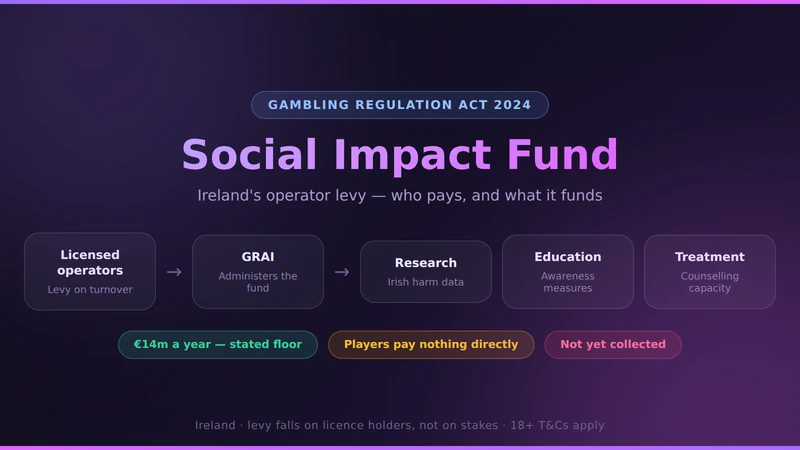
The Social Impact Fund is a pot of money, created by the Gambling Regulation Act 2024 and run by the Gambling Regulatory Authority of Ireland, that licensed gambling operators pay into through an annual levy on turnover. It funds research, public education and treatment for gambling harm — around €14 million a year is the figure that was quoted. Players pay nothing directly. And as of September 2026 no money has been collected, because the licensing that triggers the levy has only just begun.
What the rule actually says
The Gambling Regulation Act 2024 does a lot of things — it created a regulator, banned gambling advertising on television, radio and on-demand services between 05:30 and 21:00, outlawed the use of credit cards and credit facilities for gambling, and prohibited targeted inducements aimed at named individuals. The Social Impact Fund is the part that deals with money after the fact rather than behaviour before it.
The mechanism is straightforward. Every operator holding an Irish licence pays an annual contribution. The rate is set by regulation rather than written into the Act, calculated from turnover, and the Gambling Regulatory Authority both advises on the rate and administers the resulting fund. What the money can be spent on is defined narrowly: research, education and awareness, and treatment. It is not general exchequer money and it is not a compensation pot.
Research
Studies into gambling behaviour and harm in Ireland — the country has historically had very little of its own data, relying on UK prevalence figures that may not transfer.
Education and awareness
Public information measures aimed at reducing harm, including in schools and sports settings, where the link between gambling sponsorship and young audiences has been contested for years.
Treatment
Counselling and support capacity. Today most of that is carried by charity-funded services; the fund is meant to put it on a stable footing instead.
Worth being clear about: the levy is charged to operators on their turnover. It is not a tax on your stake and it is not deducted from your winnings. Winnings from gambling remain untaxed for players in Ireland, and nothing in the Act changes that.
Dates and deadlines
The fund is downstream of everything else. Nothing gets collected until operators are licensed, and operators are being licensed in phases. Here is where the sequence stands.
23 Oct 2024
Act signed into law
The Gambling Regulation Act 2024 is enacted, creating both the regulator and the Social Impact Fund on paper.
5 Mar 2025
GRAI becomes operational
The Gambling Regulatory Authority of Ireland formally starts work. Licensing does not begin yet — it spends the following year building the regime.
9 Feb 2026
Operator portal opens
Applications open for business-to-consumer remote betting licences. Casino gaming is deliberately not in this first window.
1 Jul 2026
First licences take effect
Remote betting licences come into force and a public register of licensees goes live. These are the first operators who will owe the levy.
1 Dec 2026
In-person licensing begins
Betting shops and other physical premises enter the regime.
Later phases
Remote gaming, lotteries, B2B
Online casino licensing — the category Bizzo would need — plus lotteries and business-to-business suppliers, rolling through 2027 and 2028.
Not yet set
Levy regulations and first collection
The rate has to be fixed by ministerial regulation before anything is charged. No date has been published, and no money has been collected.
What it means if you are the one playing
Your money is untouched
No deduction from deposits, balances or withdrawals. If any operator ever shows you a line item called a social impact charge, that is not this and you should query it.
Winnings stay untaxed
Ireland taxes bookmakers on turnover, not players on winnings, and the Act did not change that. The levy sits on the operator side of the same line.
But you may pay indirectly
A turnover levy is a cost, and costs move. The plausible outcomes are slightly thinner promotions and slightly worse odds at licensed operators, not a visible charge. Whether that is a fair trade for a regulated market is a judgement call.
Offshore sites contribute nothing
Bizzo and every other unlicensed casino pay into no Irish fund and answer to no Irish regulator. That is the current reality rather than an accusation — the licence category they would need does not exist yet.
There is a slightly uncomfortable point in here that most sites skip. Ireland has built a harm-reduction fund financed by the operators who will be licensed, at a moment when a large share of online casino play happens at operators who will not be — at least not for another year or two. The fund is a good idea. The gap between it and where people are actually playing is real, and it is the strongest practical reason to treat an offshore account cautiously: withdraw regularly, set your own limits, and read our verdict on Bizzo's licensing position before you decide it does not matter.
What to do about it, practically
Set your own limits rather than waiting for the register. The national gambling exclusion register is coming but is not live. Every serious casino, Bizzo included, already offers deposit, loss and session limits. Setting one takes a minute and does not depend on anybody's legislative timetable.
Stop using credit for gambling — the ban is already in force. Credit cards and credit facilities have been prohibited for gambling since the Act commenced on 5 February 2026, and that includes a wallet topped up from a credit card. Offshore sites may still accept one, and Irish issuers commonly treat a gambling payment as a cash advance — interest from day one, no grace period, plus a fee.
Use the services the fund is meant to support — they exist already. GamblingCare.ie runs a free 24-hour national helpline on 1800 936 725, and Gamblers Anonymous Ireland runs meetings nationwide. Neither is waiting on the levy.
Check the register before trusting any "Irish licensed" claim. The GRAI publishes its licensees. A site advertising an Irish licence that is not on that register is misrepresenting itself, and that tells you everything you need to know about the rest of its claims.
Where it does not do what people hope
It is not compensation
There is no application form and no individual payout. If you have lost money and believe an operator behaved improperly, the fund is not your route — the operator's complaints procedure is, and after that its regulator. Our page on closed accounts sets out that sequence.
It does not reach offshore play
A levy on licensees only captures licensees. Until remote gaming licensing is complete, the largest part of Irish online casino activity sits outside the fund entirely — and outside the advertising rules, the credit card ban and the exclusion register with it.
The €14 million figure is a target, not a receipt
It came out of the legislative debate, not from a collection. The real number depends on a rate that has not been set and a licensee population that is still forming. Anyone quoting it as current income is guessing.
Nothing here is fast
Licence, then levy regulation, then collection, then disbursement, then services actually hiring. Each step is measured in quarters. If you are looking for something that helps in the next month, it is the helpline, not the fund.
Sources
Primary material only. Where this page gives a figure or a date, it came from one of these — and where something has not been decided yet, we have said so rather than filling the gap.
-
Gambling Regulation Act 2024 — Irish Statute Book
The Act as enacted, including the provisions establishing the Authority and the Social Impact Fund.
-
Gambling Regulatory Authority of Ireland
Licensing phases, the public register of licensees, and the Authority's own guidance and strategy statement.
-
Citizens Information — Gambling Regulatory Authority
A plain-English summary of the regime, maintained by the State rather than by the industry.
-
GamblingCare.ie
Free national helpline and counselling services — the kind of provision the fund is designed to support.
Common questions about the fund
What is the gambling Social Impact Fund in Ireland?
Who pays the Social Impact Fund levy?
How much money will the Social Impact Fund raise?
Does the Social Impact Fund apply to Bizzo Casino?
When does the Social Impact Fund start paying out?
What does the fund actually pay for?
Can I claim money from the Social Impact Fund?
Where can I read the legislation myself?
The part you control
The levy is somebody else's timetable. Your deposit limit is not. Set one before your next session, and if you want the full picture on where Bizzo sits in the Irish regime, read our licensing verdict.
18+. Gamble responsibly. Free confidential help in Ireland: 1800 936 725.